

Artificial intelligence (AI) is often hailed as the driving force behind a new era of productivity and economic transformation. From Wall Street’s investment forecasts to Silicon Valley’s relentless innovation campaigns, AI has become a central pillar in discussions about America’s economic future.
The narrative is compelling: machines that learn, automate, and optimize human work could finally push U.S. productivity into a new golden age one reminiscent of the post World War II boom. Yet, beneath the enthusiasm lies a crucial question: is this productivity boom real, or is it mostly hype fueled by investor optimism and media fascination?
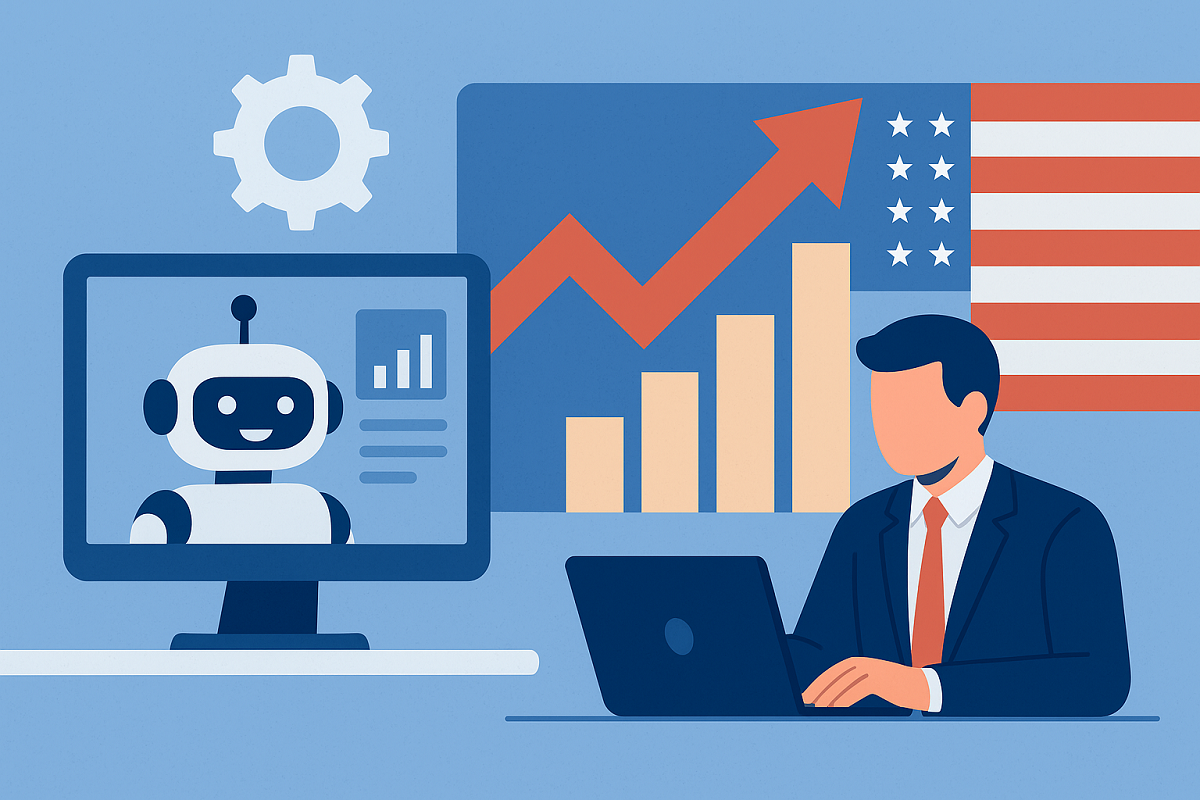
Over the past two years, U.S. labor productivity has shown notable improvement, following nearly two decades of stagnation. Data from the Bureau of Labor Statistics (BLS) shows that productivity in the nonfarm business sector rose at an annual rate exceeding 3% in 2023 and 2024 figures that sparked excitement about a potential turning point.
Policymakers, economists, and business leaders have rushed to attribute these gains to AI adoption, pointing to rapid advances in generative AI tools, machine learning systems, and automation technologies. However, a deeper look reveals a more complex and uneven picture one where AI’s transformative potential remains largely concentrated in certain sectors while many others have yet to feel its impact.
A Look Back: America’s Long Productivity Slowdown
To appreciate the magnitude of today’s debate, it’s worth understanding the historical context. The U.S. experienced extraordinary productivity growth during the mid-20th century, driven by industrial expansion, infrastructure investment, and technological progress. Between 1948 and 1973, productivity grew at an average annual rate of around 3%. This was the era of assembly lines, postwar reconstruction, and mass consumer markets.
But from the 1970s onward, the story changed. Productivity growth slowed dramatically, puzzling economists despite the digital revolution. The 1990s brought a temporary rebound fueled by personal computing and the internet, yet the early 2000s and 2010s returned to sluggish growth, even as smartphones, cloud computing, and e-commerce transformed daily life. The paradox was clear: technology seemed everywhere except in the productivity statistics.
By the time AI emerged as a mainstream economic force in the 2020s, the U.S. had been grappling with almost 20 years of tepid productivity performance. Therefore, any suggestion that AI could reverse this trend naturally attracted intense attention. Could artificial intelligence finally do what past waves of technology failed to achieve deliver sustained, economy-wide productivity growth?
The AI Productivity Surge
Starting in 2023, U.S. productivity data began to show signs of acceleration. Quarterly reports revealed consistent gains, and industries like information technology, finance, and manufacturing led the charge. Some analysts declared this the beginning of the “AI productivity boom.”
AI’s impact appeared to come from three major channels.
Automation of routine tasks: From data entry to logistics management, AI-driven automation software drastically reduced the time and labor needed for repetitive tasks.
Enhanced decision-making: Machine learning algorithms optimized resource allocation, pricing strategies, and inventory management. In finance, AI models improved risk assessment and fraud detection.
Generative AI for creative and cognitive work: Tools like ChatGPT, Claude, and Copilot made it possible to generate documents, write code, or draft marketing materials in minutes, improving the productivity of knowledge workers.
According to a Goldman Sachs report, AI could eventually raise global GDP by 7% over a decade, largely through productivity enhancements. In the U.S., the gains could be even more pronounced given the country’s high digital adoption rate and concentration of AI-related investment.
Still, not all productivity growth should be attributed to AI. Economists caution that cyclical factors such as post-pandemic adjustments, tight labor markets, and capital deepening—also contributed. Separating genuine AI-driven improvements from broader macroeconomic recovery remains a challenge.
Generative AI
Perhaps the most striking aspect of the AI revolution is its impact on white-collar productivity. For decades, automation primarily affected blue-collar and routine manufacturing jobs. But with the rise of generative AI, knowledge work itself is being transformed.
Professionals in law, marketing, journalism, finance, and software engineering now use AI tools to handle tasks that once consumed hours. AI-powered assistants can summarize documents, analyze data sets, draft contracts, or write code snippets. McKinsey & Company estimates that generative AI could automate up to 30% of work activities in advanced economies by 2030, potentially freeing employees to focus on higher-value, creative, and strategic work.
However, this transformation raises important questions about quality, oversight, and the true value of productivity. While AI can generate output faster, does it necessarily produce better outcomes? Early studies suggest that productivity gains often come with trade-offs in accuracy or originality. Moreover, the biggest benefits tend to accrue to organizations that integrate AI into workflows systematically, rather than treating it as a simple plug-and-play tool.
Industrial AI and the Manufacturing Resurgence
While much of the media coverage focuses on AI’s role in digital and creative sectors, the real test of its transformative power lies in industrial applications. Manufacturing, logistics, and energy are sectors where productivity gains have the greatest macroeconomic impact.
In recent years, U.S. industrial policy particularly under the CHIPS and Science Act and the Inflation Reduction Act has accelerated domestic investment in semiconductors, clean energy, and advanced manufacturing. AI is playing a critical role in these initiatives. Smart factories now use machine learning to predict maintenance needs, optimize supply chains, and reduce waste. AI-driven robotics enhance precision in assembly lines, while energy systems use AI forecasting to balance grid loads and improve efficiency.
If these industrial applications scale effectively, they could mark the beginning of a new wave of industrial productivity one supported by government incentives, private innovation, and AI-enabled optimization. However, adoption remains uneven: many small and mid-sized manufacturers still lack the capital or expertise to implement AI systems effectively.
The Infrastructure Challenge
Even as optimism grows, the AI productivity story faces significant infrastructural bottlenecks. High-performance computing, vast data resources, and specialized talent are prerequisites for successful AI integration.
Large corporations like Google, Microsoft, and Amazon command these assets, enabling them to achieve significant efficiency gains. But smaller firms representing the majority of the U.S. economy struggle with access to compute resources and skilled personnel. This uneven distribution of AI capabilities risks creating a productivity divide between tech-rich and tech-poor sectors.
Moreover, energy consumption has become a growing concern. The data centers powering AI models require enormous amounts of electricity. As demand for generative AI services rises, the U.S. faces an emerging tension between technological expansion and energy sustainability. Without addressing these structural issues, the productivity boom could plateau before reaching its full potential.
Skepticism
Despite glowing projections, not all economists are convinced. Some argue that the current excitement mirrors past overestimations of emerging technologies. The Solow Paradox named after Nobel laureate Robert Solow famously noted that “you can see the computer age everywhere but in the productivity statistics.” Similar patterns could emerge with AI.
In this view, early productivity gains may be short-lived or localized, driven by novelty effects rather than long-term efficiency. Companies may initially boost output through automation, but true productivity growth requires structural transformation new processes, new management models, and complementary human skills.
There is also the issue of measurement. Traditional productivity metrics may not capture the full value created by AI. Many AI applications improve quality or innovation rather than pure output per labor hour. For example, a marketing team using AI to create more effective campaigns may boost sales, but that improvement doesn’t always appear directly in productivity statistics.
Furthermore, as AI tools proliferate, so do concerns about bias, misinformation, and overreliance on machine-generated content. Poor implementation could lead to inefficiencies or reputational risks, offsetting the gains AI promises.
Economic Implications
AI-driven productivity growth could profoundly reshape the U.S. labor market. On one hand, higher productivity typically supports higher wages and economic growth. On the other, automation may displace certain job categories faster than new ones emerge, intensifying inequality and job polarization.
Knowledge workers who can leverage AI to amplify their output may see rising incomes, while routine clerical or analytical roles could shrink. This dynamic is already visible in corporate restructuring trends: some firms have announced workforce reductions citing AI efficiency, while others have upskilled staff to integrate AI tools.
For policymakers, this raises a difficult balance. The challenge is not just maximizing productivity, but ensuring its benefits are broadly shared. Without careful policy design such as worker retraining programs, education reforms, and equitable access to AI tools—the productivity boom could deepen existing economic divides.
AI’s Role in Public Administration and Infrastructure
Beyond the private sector, AI’s potential to transform government productivity is often overlooked. Public agencies are experimenting with AI for service delivery, data analysis, and infrastructure planning.
For example, predictive analytics can help allocate resources more efficiently in healthcare and social services. AI-driven modeling supports climate resilience efforts, enabling smarter investment in flood control, energy grids, and transportation. These applications may not always appear in GDP figures, but they significantly enhance public-sector productivity and national competitiveness.
Moreover, AI’s integration into critical sectors—such as defense, logistics, and pharmaceuticals—aligns with the broader trend of strategic industrial policy. By investing in AI infrastructure and public-private partnerships, the U.S. government aims to strengthen economic security while accelerating innovation.
The Real Transformation
The most sustainable productivity growth doesn’t come from AI replacing humans it comes from AI augmenting human capabilities. Research consistently shows that when AI is used as a collaborative tool, combining human judgment with machine efficiency, performance improves more than when either operates alone.
This principle of “complementarity” is key to understanding AI’s long-term impact. Workers who learn to use AI effectively—whether in programming, finance, or healthcare—will likely see exponential gains in output and creativity. Businesses that invest in AI literacy and process redesign will capture more of the technology’s potential.
The danger lies in assuming that deploying AI automatically yields productivity. Without organizational adaptation—rethinking workflows, incentives, and management structures—AI’s benefits remain fragmented.
FAQs
Is AI really improving U.S. productivity?
Yes, recent data shows measurable productivity gains in sectors adopting AI. However, the improvements are uneven and may take years to fully materialize across the economy.
Which industries benefit most from AI-driven productivity?
Technology, finance, logistics, and manufacturing currently see the biggest gains, while healthcare and public administration are emerging adopters.
Could AI cause job losses in the U.S.?
AI may automate some routine roles, but it also creates new opportunities in data science, software development, and AI management. The net effect depends on how fast workers can adapt.
What challenges could limit the AI productivity boom?
High energy costs, lack of skilled labor, uneven access to computing power, and regulatory hurdles could slow widespread adoption.
Is AI’s productivity potential overhyped?
Some experts believe so, arguing that we are still in the early adoption phase. True productivity growth will depend on organizational and societal adaptation, not just technology itself.
How Trump’s H-1B Visa Crackdown Could Disrupt America’s Tech Industry