
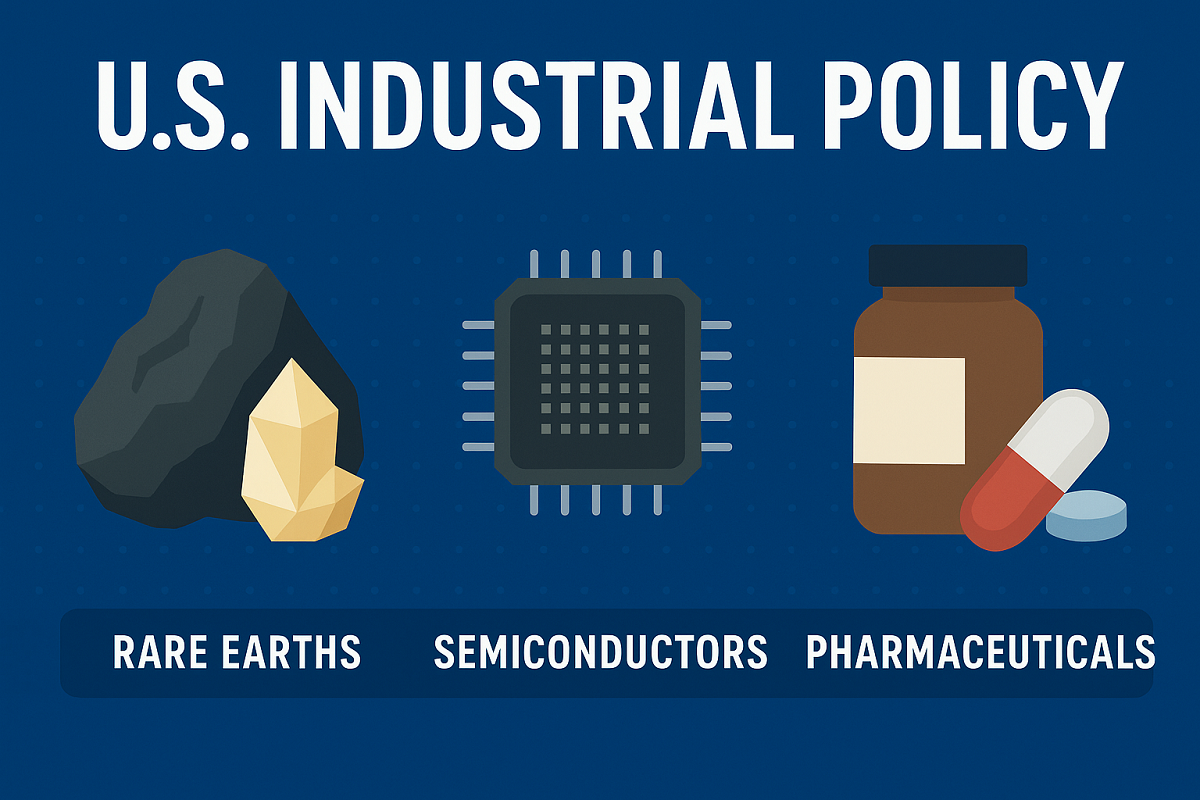
Over the last few years the United States has quietly and sometimes not so quietly shifted from the comfortable assumption that private markets and global supply chains could be relied upon to deliver strategic goods to a posture that treats certain supply chains as matters of national security.
That change shows up in three visible ways: large-scale targeted subsidies and tax credits (most famously the CHIPS and Science Act for semiconductors), direct public investments and equity stakes in private firms (recently visible in rare-earths deals), and a renewed push to rebuild domestic biopharmaceutical manufacturing capacity through agencies like BARDA and executive action using authorities such as the Defense Production Act.
These moves represent a resurgent industrial policy that mixes carrots (grants, tax credits, procurement guarantees) and sticks (buy-American preferences, stricter foreign inspections) and increasingly direct government ownership or quasi-ownership where policymakers deem market incentives insufficient or geopolitical risk too high.
I’ll walk through the drivers of the shift, what governments are actually doing in each sector (semiconductors, rare earths, pharmaceuticals), the advantages and risks of the new approach, and some practical design principles that could keep industrial policy effective and politically legitimate.
Why now? strategic fragility China, and the post pandemic lesson

Two big shocks shifted perceptions: the COVID-19 pandemic exposed the fragile dependence of U.S. health-product supply chains on foreign manufacturers, particularly for active pharmaceutical ingredients (APIs) and sterile injectables; and the global semiconductor shortage of 2020–22 made clear how deeply modern economies and defense systems depend on advanced chips.
At the same time, the rapid supply-chain industrial strategy deployed by China including state-led investment across mining, processing, advanced manufacturing, and export control levers convinced many U.S. policymakers that “market outcomes” alone would not produce reliable access to strategically important inputs.
Policymakers now view certain goods not simply as economic commodities but as public-good inputs to national security and technological leadership. That reorientation undergirds the modern U.S. industrial policy push: resilience, friend-shoring, and an attempt to rebuild domestic capacity in sectors where geopolitical adversaries currently hold outsized influence.
The policy tool kit
Modern U.S. industrial policy is not one tool but many. It includes direct grants and matching funds, tax credits for domestic investment, public procurement commitments that reduce market risk for firms building capacity, loan guarantees, expanded regulatory inspections to disincentivize risky offshore production, and use of the Defense Production Act to accelerate domestic production of priority goods.
More recently, the government has begun to consider or actually take direct equity stakes in private firms as a mechanism to ensure long-term alignment of production with strategic needs and to lock in domestic capability when other inducements are insufficient.
This mixture reflects a pragmatic recognition: sometimes subsidies and procurement guarantees are enough; sometimes the government must make a deeper financial commitment to move capital-intensive projects forward or to secure output.
The CHIPS Act is the largest single example of subsidy + tax credit policy; the government’s recent moves in rare earths illustrate the turn toward public-private equity partnerships; and BARDA’s investments show the continuation of pandemic-era efforts to shore up domestic biomanufacturing capacity. Congress.gov+2MP Materials
Semiconductors
Semiconductors are the clearest poster child for the new U.S. industrial policy. The CHIPS and Science Act, enacted in 2022, appropriated roughly $52 to 53 billion specifically targeted at semiconductor manufacturing, incentives, and research in the United States, plus broader science and technology funding.
That package uses large grants and tax credits to reduce the effective cost of building fabs in the U.S., offsets the huge capital intensity of advanced foundries, and includes research and workforce funding to sustain longer-term competitiveness.
The policy’s explicit aim is not only economic to create jobs and anchor production domestically but also geopolitical: to reduce U.S. dependency on foreign producers, to preserve secure supply chains for defense and critical infrastructure, and to ensure that the most advanced nodes and related IP remain on friendly soil. The CHIPS Act’s combination of direct funding, tax incentives, and research investments represents a textbook modern industrial policy: targeted, large, and long-term.
This public financing has already reshaped corporate decisions: firms that had previously favored lower-cost locations announced U.S. fab investments once the subsidy calculus changed. But subsidies alone are imperfect. Building a leading-edge fab requires a cluster of specialized suppliers, a trained workforce, and decades of equipment and supplier relationships.
That’s why the CHIPS Act’s funding was designed to be layered: grants to lower upfront capex barriers, an investment tax credit to keep ongoing build-out attractive, and research and workforce dollars to grow the supporting ecosystem.
The scheme is explicitly defensive in orientation a response to the geopolitical risk of concentrated production but it also aims to create commercially viable domestic industry rather than indefinite subsidy dependence.
One politically and economically delicate question is whether subsidies should be accompanied by equity or other long-term government ownership stakes. Proponents argue that equity gives the public a stake in future upside, aligns corporate incentives with national objectives, and can be structured with conversion options that protect taxpayers.
Critics fear politicization, the risk of inefficient allocation, and the moral hazard of picking “winners.” Washington has so far favored grants and tax credits for chips, but that calculus could change if private actors refuse to invest at scale even with subsidies especially if rival states (including allies) begin to lock in preferential treatment that disadvantages U.S. firms.
Rare earths and critical minerals
Rare earth elements and certain critical minerals are not rare in geological terms but are concentrated in processing and refining capacity historically dominated by China which creates strategic vulnerability.
The U.S. approach in the last several years moved from policy statements to concrete investments: loans, procurement guarantees, and in some cases direct capital injections into projects that build refining and magnet manufacturing capacity domestically.
A striking, contemporary example is the U.S. government’s large financial commitment and resulting equity position with MP Materials (the company that operates the Mountain Pass rare-earth mine). Recent public-private deals have included large Department of Defense commitments to accelerate magnet production and have effectively given the government a meaningful equity stake in the company to better secure supply and output commitments.
Those deals combine capital, offtake or purchase guarantees, and conversion rights an approach that treats secure supply as a strategic infrastructure investment rather than a simple market purchase. MP Materials
Why take equity? For rare earths, the answer is straightforward: processing and magnet production require long lead times and bear meaningful market and political risk. If the private sector alone will not accept those risks (especially when global competitors are willing to underprice or use state backing), then public capital can accelerate projects and, where appropriate, secure returns or convert grants into equity to protect taxpayers’ interests.
In some cases the government has also contemplated price floors or strategic stockpiles to stabilize domestic production economics, and the Defense Production Act has been invoked to prioritize domestic mineral production as a strategic capability. Those tools change the risk-return profile of capital-intensive projects and create a clearer path to building a domestic processing chain.
Pharmaceuticals
The pandemic drove a rethinking of pharmaceutical supply chains. The U.S. imports a large share of APIs and finished sterile injectables, and shortages during global stress made health security an urgent policy priority.
The Biomedical Advanced Research and Development Authority (BARDA) and other HHS programs moved rapidly during COVID to expand surge capacity for vaccines and therapeutics, and more recent policy pushes have focused on expanding domestic fill/finish, API production, and resilient supplier networks.
BARDA’s Pharmaceutical Countermeasures Infrastructure program and related initiatives have committed billions to shore up domestic biopharmaceutical surge capacity, with explicit goals to create a continuous base of manufacturing capabilities (vials, single-use technologies, raw materials, aseptic fill/finish) that can be rapidly scaled in an emergency.
Those investments are not pure charity: they reduce the social cost of pandemics and supply shocks but they also require careful contracting to ensure private partners have routine commercial business to maintain capacity between crises.
Regulatory levers complement financial support. The FDA has signaled increased foreign facility inspections and higher scrutiny for manufacturers abroad who supply the U.S. market, raising the compliance bar for offshore production and nudging some firms to consider reshoring.
Direct procurement guarantees, advanced market commitments, and public-private manufacturing partnerships have been used to create a baseline commercial flow that keeps factories economically viable even outside crisis periods. The policy goal is resilience: ensure that when the next global shock arrives, domestic capacity can surge quickly without the time-consuming onboarding of new suppliers.
What public equity stakes change and why some administrations prefer them
Traditionally, Anglo-American industrial policy relied on subsidies and procurement rather than government ownership. But recent events particularly in the rare-earths arena demonstrate why some policymakers are now comfortable with equity stakes. Stakes can:
Secure long-term alignment. Equity or preferred stock with conversion rights can bind company behavior (e.g., domestic processing guarantees) across business cycles in ways that short-term grants cannot.
Leverage private management. Public ownership need not mean public management. The government can be a passive investor while contracts and governance terms protect strategic outputs.
Share financial upside. If public capital de-risks a big industrial bet, taxpayers may reasonably expect a return rather than a pure subsidy cost.
Signal commitment. Large equity commitments combined with procurement guarantees — can attract further private capital and anchor supply chains.
But stakes bring risks: political interference, risk of mispricing companies, long timelines for exit, and the possibility that government ownership crowds out more efficient private financing. Crafting the right governance limited board seats, conversion terms, sunset clauses, clear performance milestones, and transparent valuation processes is essential to reduce distortion and protect taxpayers.
Recent reporting shows that the U.S. government has already executed deals that result in material equity positions in strategic companies, and some policymakers are openly considering expanding this approach to other critical sectors (from semiconductors to pharmaceuticals) where market failures and geopolitical pressures are acute. Those developments represent an important evolution from subsidy/guarantee approaches toward a more hands-on industrial investor role in narrowly defined strategic areas. Reuters
Benefits costs and political economy trade-offs
Expanding industrial policy into equity stakes and large procurement commitments creates immediate advantages but also long-term trade-offs.
Benefits
Faster capacity buildup for goods that are capital-intensive and slow to commercialize (fabs, refineries, sterile drug plants).
Better alignment of private incentives with public security needs via offtake guarantees and conditional financing.
Potential for taxpayer returns if investments are structured as equity or convertible instruments.
A geopolitical tool: investments and procurement rules can be combined with allied cooperation to build resilient networks among friendly countries.
Costs and risks
Fiscal exposure: large commitments can become expensive if projects fail or require ongoing subsidy.
Political risk and politicization: government equity may draw criticism for “picking winners” or be used as political leverage by future administrations.
Market distortion: aggressive subsidies or government ownership can induce inefficient entry or lead to subsidy competition among countries.
Implementation complexity: public investment programs require skills (project selection, commercial negotiation, valuation) that government bodies are only partially equipped to scale quickly.
Two acute political-economy tensions complicate policy design. First, credibility: industrial policy must be credible across administrations; if champions and terms change every election cycle, private investors will demand higher returns to compensate for political risk. Second, exit: policymakers must plan for how and when to privatize or sell government stakes to avoid indefinite state ownership of commercial enterprises.
Practical policy design principles how to get it right
If the U.S. is going to continue to expand the role of public capital in critical sectors, here are practical design principles that improve outcomes while limiting downside:
Target narrowly and transparently. Intervene only in clearly identified strategic market failures (e.g., lack of domestic processing capacity for rare earths, strategically important node shortage for semiconductor fabrication, or critical gaps in biomanufacturing surge capacity). Transparent criteria reduce accusations of favoritism.
Mix instruments wisely. Use the least-distorting tools first (grants, procurement commitments, tax credits), escalate to loans/guarantees when necessary, and reserve equity for cases where long-term alignment and deep de-risking are essential. Equity should be structured with clear conversion rules and exit pathways. The government should aim to be a catalytic investor, not a perpetual owner. (Examples today show this hybrid approach in action.) Congress.gov
Insist on commercial discipline. Even when national security motives predominate, contracts should include commercial milestones, clawbacks, and performance-based payments. Public investments should be benchmarked to market comparators to avoid overpayment.
Coordinate with allies. Industrial policy is more effective and less likely to spark subsidy races if designed and executed with like-minded partners. Shared procurement commitments and co-financing reduce costs and build credible friend-shoring networks.
Protect governance and depoliticize operations. Create specialized, quasi-independent vehicles or funds with professional investment teams to manage equity stakes (analogous to sovereign or strategic investment vehicles), with oversight but distance from daily politics.
Plan for workforce and cluster effects. Money for fabs or pharma plants without workforce development and supplier development leaves projects fragile. Combine capital with long-term workforce and supplier ecosystem investments.
Use regulatory levers to complement finance. Increased inspection, enforcement, and higher standards for foreign facilities raise the bar for offshore suppliers and sharpen the economic case for domestic investment — but these moves must be proportional and internationally defensible under trade rules.
Geopolitical implications
Industrial policy is often framed as either “de-risking” (diversifying and securing supply from trusted partners) or “decoupling” (an attempt to sever economic ties).
The practical U.S. approach since 2020 has emphasized de-risking reduce dependence on single sources, build capacity with allies, and use procurement to favor trusted suppliers but recent rhetoric and some actions suggest a stronger posture that can look like partial decoupling, particularly in the most strategic nodes (advanced chips, certain critical minerals, and strategic pharmaceuticals).
If broadly adopted, equity-style interventions could accelerate de-risking by creating credible long-term domestic capacity that allies can count on. But there is also a real risk of tit-for-tat subsidy competition with other major economies (the EU has its own Chips Act; China offers aggressive subsidies and export controls).
That competition could raise the global cost of producing advanced goods and narrow margins for private firms. The most durable way to avoid a destructive subsidy race is multilateral coordination among like-minded democracies: shared standards, co-financing, and reciprocal procurement frameworks that bind partners into cooperative resilience networks.
Real-world examples and takeaways
We can see all of these dynamics playing out in recent deals and policy moves. The CHIPS Act’s multi-billion dollar package demonstrates the scale of subsidy policy for semiconductors a mix of grants, tax credits, and research funding designed to anchor advanced fabs in the U.S. and rebuild the workforce. Congress.gov
In rare earths, the Department of Defense’s recent public-private commitment to MP Materials including a multibillion dollar purchase and a large preferred-stock investment that gives the government an effective equity position shows a readiness to use equity and offtake guarantees to accelerate domestic magnet production and reduce foreign dependence. That deal is a vivid example of moving from light-touch incentives to long-term strategic ownership when the cost of failure is judged too high. MP Materials
In pharmaceuticals, BARDA and related authorities have been channeling billions into capacity that supports surge manufacturing for vaccines and therapeutics, while regulatory agencies have increased direct inspections and enforcement of foreign manufacturing facilities to reduce safety and supply risks.
These investments are designed to maintain critical capacity in between crises, and to reduce the chance that shortages or contamination events in offshore plants will cripple U.S. medical responses. medicalcountermeasures.gov
Finally, executive use of the Defense Production Act and new critical minerals directives show that successive administrations view minerals as a strategic priority and are willing to deploy emergency industrial authorities to accelerate domestic production and prioritize capacity for defense and critical infrastructure. The White House
Further reading
Congressional Research Service, CHIPS Act of 2022: Provisions and Implementation. Congress.gov
MP Materials press release and Department of Defense partnership announcement. MP Materials
BARDA: Pharmaceutical Countermeasures Infrastructure (PCI) and related investments in U.S. biomanufacturing surge capacity. medicalcountermeasures.gov
White House action on immediate measures to increase American mineral production and DPA use. The White House
Recent reporting on expanded government stakes and statements from Treasury leadership about taking government stakes in strategic companies. Reuters