

In 2025, the nature and scope of federal crimes in the United States are evolving faster than ever before. As society becomes more digitally interconnected, economically complex, and politically polarized, the types of offenses that federal authorities are dealing with have become increasingly diverse and difficult to predict. From sophisticated cyberattacks on national infrastructure to escalating domestic extremism and the proliferation of synthetic opioids like fentanyl, the United States finds itself at a pivotal moment in the battle against crime at the federal level.
Understanding federal crime trends is essential not just for law enforcement agencies and policymakers but for everyday citizens, business owners, journalists, students, and educators. The U.S. legal and judicial system classifies federal crimes as those that violate statutes enacted by Congress and are prosecuted by United States Attorneys in federal courts. These crimes typically involve larger jurisdictions, interstate or international elements, and higher stakes both financially and socially.
What Exactly Are Federal Crimes?
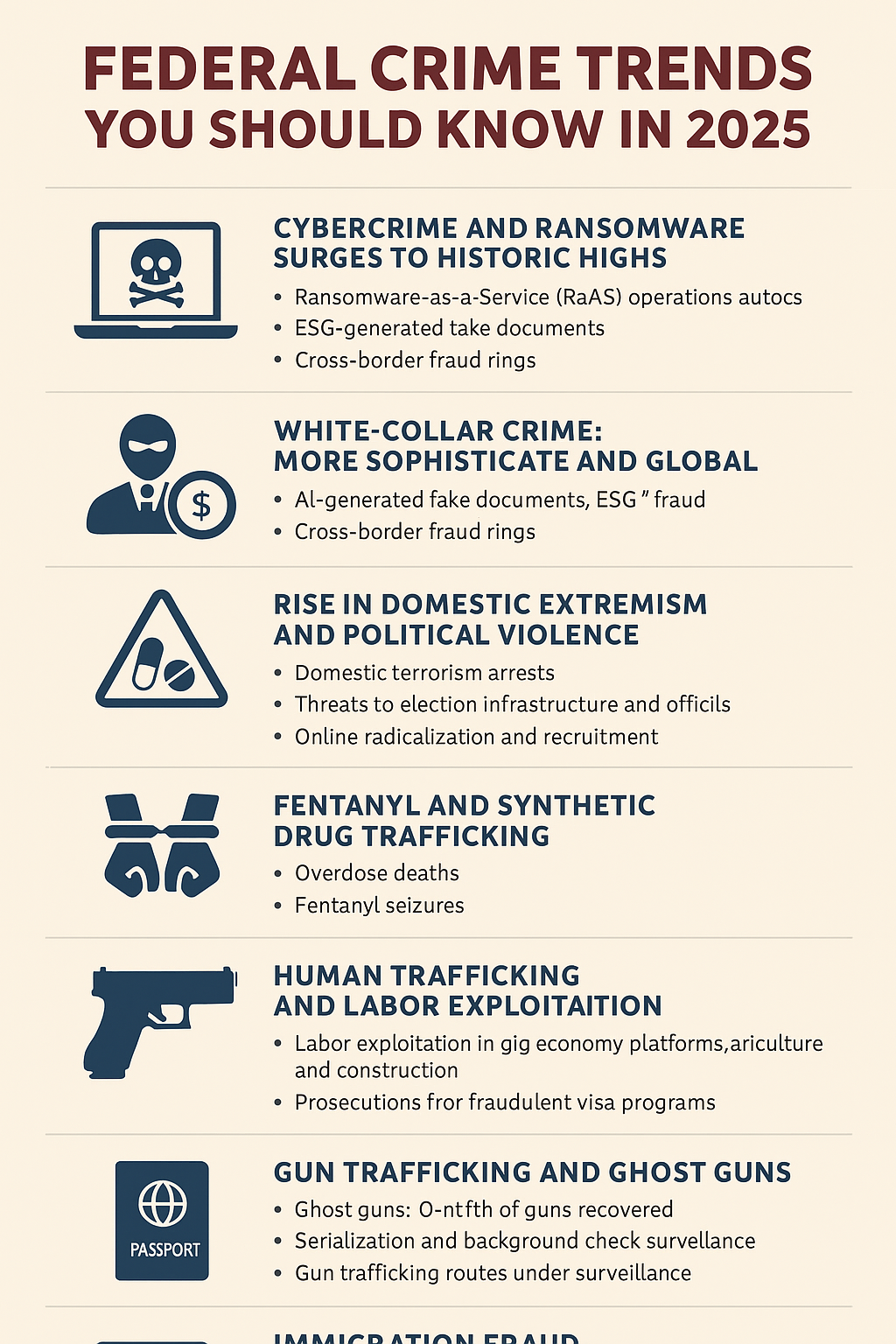
Before diving into the emerging trends, it’s important to understand the nature of federal crimes. Federal offenses differ from state-level crimes in that they usually cross state lines, affect national interests, involve federal property, or violate federal statutes. These crimes are investigated by federal law enforcement agencies such as the Federal Bureau of Investigation (FBI), the Drug Enforcement Administration (DEA), the Bureau of Alcohol, Tobacco, Firearms and Explosives (ATF), Immigration and Customs Enforcement (ICE), and the Department of Homeland Security (DHS).
Some of the most common types of federal crimes include cybercrime, white-collar fraud, terrorism, drug and human trafficking, immigration violations, firearms offenses, and crimes involving interstate commerce. Federal crimes usually carry heavier penalties and longer prison sentences than similar offenses prosecuted at the state level. Given the severity and national impact of many federal crimes, they remain a top priority for the U.S. Department of Justice (DOJ) and other federal agencies.
Cybercrime and Ransomware: A National Emergency
Arguably the most explosive category in federal criminal investigations in 2025 is cybercrime. In the past decade, the landscape of cyber threats has escalated beyond identity theft and phishing scams into a full-blown war involving ransomware attacks, corporate espionage, cryptocurrency scams, and foreign interference in critical infrastructure.
In 2025, the FBI’s Internet Crime Complaint Center (IC3) reported a record-breaking $12.3 billion in losses from internet-based crimes. Ransomware, in particular, has grown in complexity, scale, and frequency. Malicious actors, often sponsored by rogue nation-states or operating from cybercrime havens in Eastern Europe and Asia, are targeting hospitals, electrical grids, universities, banks, and municipal governments. These attacks paralyze systems, steal sensitive data, and extort millions in cryptocurrency payments, often in hard-to-trace currencies like Monero.
What makes today’s cybercrimes so dangerous is the use of AI-generated malware and deepfakes. In some instances, attackers have used synthetic voice cloning to impersonate CEOs or government officials, tricking employees into transferring funds or granting access. The cyber landscape has become a digital battlefield, and federal agencies have responded by investing heavily in artificial intelligence, blockchain forensics, and inter-agency cyber task forces. The Biden administration, along with Congress, is expected to push forward mandatory cybersecurity compliance for private companies in the second half of 2025.
White-Collar Crime AI, ESG Fraud, and Global Schemes
White-collar crime — traditionally associated with non-violent financial offenses — has entered a new era in 2025. The days of Ponzi schemes and insider trading as the primary threats are long gone. Now, the U.S. Securities and Exchange Commission (SEC), Financial Crimes Enforcement Network (FinCEN), and DOJ are grappling with a web of sophisticated schemes involving AI manipulation, blockchain-based scams, and fraudulent ESG (Environmental, Social, and Governance) reporting.
One growing concern is the emergence of deepfake financial news, generated by AI to manipulate public perception and stock prices. In one high-profile case in early 2025, a deepfake video of a tech CEO announcing a fictitious merger wiped $6 billion off a rival company’s market cap in just one afternoon. The SEC quickly intervened, opening a new department focused entirely on AI-driven market manipulation.
Another alarming trend is the fabrication of ESG data to lure investors. Many companies are now being investigated for overstating their sustainability achievements — a phenomenon known as “greenwashing” — to obtain tax credits or attract socially conscious investors. As trillions of dollars flow into green finance and ESG funds, the potential for abuse has skyrocketed, prompting federal regulators to tighten auditing standards and increase penalties for misrepresentation.
Domestic Extremism Polarization Fuels Violence
Over the past five years, the United States has seen an alarming rise in domestic terrorism and extremist violence. In 2025, this issue continues to intensify, with law enforcement reporting over 200 federal arrests for domestic terrorism-related charges in just the first half of the year.
Unlike traditional foreign terrorism threats, today’s domestic extremism stems largely from ideological radicalization within U.S. borders. Militia groups, white supremacists, eco-terrorists, and anti-government extremists have grown increasingly active and violent. Much of this radicalization occurs in online echo chambers, social media platforms, and encrypted messaging apps, making it difficult for authorities to monitor and prevent plots before they materialize.
The FBI and DHS have prioritized countering this threat through the creation of specialized Domestic Terrorism Task Forces. These units are trained to use advanced digital forensics, social network mapping, and behavioral analysis to identify high-risk individuals and disrupt plots. Additionally, the Biden administration has increased funding for community-based de-radicalization programs and proposed new legislation to explicitly define domestic terrorism under federal law. However, debates over civil liberties and government overreach continue to complicate these efforts.
Fentanyl and Synthetic Drug Trafficking America’s Deadliest Crisis
Perhaps no federal crime has caused as much widespread devastation as the opioid crisis, and fentanyl remains at the center of this national emergency in 2025. Synthetic opioids like fentanyl are now responsible for the majority of drug overdose deaths in the United States. According to the CDC, over 80,000 Americans died of synthetic opioid overdoses in 2024 alone, and the numbers are climbing in 2025.
What makes fentanyl particularly dangerous is its potency as little as two milligrams can be lethal and its ability to be easily modified into legal gray-area analogs. Criminal networks have adapted by synthesizing slightly altered compounds that skirt the Controlled Substances Act, allowing them to manufacture and distribute new variants faster than regulators can outlaw them.
The DEA, working alongside the Department of Homeland Security and international partners, has intensified efforts to disrupt these supply chains. Most precursor chemicals are traced back to labs in China, with Mexico serving as the primary transshipment hub into the U.S. Border security has been bolstered by AI-enhanced scanning technologies and canine units trained specifically to detect synthetic opioids in powder, pill, and liquid form.
Human Trafficking: Hidden in Plain Sight
Human trafficking, both for sexual exploitation and forced labor, continues to plague communities across America. While much attention has historically focused on sex trafficking, federal agencies in 2025 are seeing significant growth in labor trafficking, particularly within the gig economy, agriculture, hospitality, and construction sectors.
Modern trafficking schemes are often masked by legitimate-looking business operations, making them difficult to detect. Traffickers exploit legal loopholes in visa programs, use fraudulent contracts, and frequently change business names to avoid detection. Victims are often undocumented immigrants or vulnerable individuals coerced through threats, debt bondage, or isolation.
The Department of Justice, through its Human Trafficking Prosecution Unit, and ICE’s Homeland Security Investigations (HSI), have increased their use of technology to trace digital footprints, such as payment logs, social media profiles, and online advertisements. Project NOVA, launched in early 2025, aims to identify trafficking rings that operate through cryptocurrency and peer-to-peer platforms.
Gun Crimes and Ghost Guns A Growing Federal Concern
Firearm-related crime remains a major concern for federal law enforcement in 2025, particularly with the growing use of ghost guns—unregistered, untraceable firearms built using 3D printers or DIY kits. According to the ATF, nearly 20% of all guns recovered in criminal investigations this year were ghost guns.
Ghost guns have become popular among criminals and extremists because they can be easily assembled without a serial number and without passing through a federally licensed firearms dealer. In response, the federal government passed the Ghost Gun Regulation Act, requiring all gun kits to include serial numbers and buyers to undergo background checks.
Interstate gun trafficking also remains a serious issue, with weapons often being purchased in states with looser regulations and transported to cities with stricter laws. The ATF and FBI continue to investigate and prosecute large-scale trafficking networks, especially those linked to drug cartels and organized gangs.
Immigration and Border Crime Visa Fraud, Smuggling, and Corruption
Immigration-related offenses are among the most politically charged federal crimes in the United States. In 2025, there is a noticeable rise in immigration fraud, including falsified asylum applications, sham marriages, and counterfeit visas.
At the same time, human smuggling at the southern border has become more technologically advanced. Smuggling organizations are now using AI navigation tools, drones, and mobile payment apps to move people and money undetected. This innovation makes it more difficult for Border Patrol and ICE to anticipate routes and intercept traffickers.
The DOJ and DHS are focusing more attention on the employers who benefit from undocumented labor, particularly those using subcontractors to maintain plausible deniability. Multiple federal prosecutions are underway in 2025 targeting national franchises and large farms for knowingly hiring undocumented workers under exploitative conditions.
Environmental and Climate-Related Crimes
With climate change dominating policy discussions, environmental crime has moved up the priority list for federal enforcement. In 2025, the DOJ’s newly formed Environmental Justice Division is cracking down on companies that violate environmental laws, including illegal dumping, air and water pollution, and fraudulent environmental claims.
There has also been a rise in carbon credit fraud, where companies sell fake or double-counted carbon offsets to meet regulatory or investor expectations. These crimes not only hurt the environment but also undermine global sustainability efforts.
Federal agencies are now using satellite imagery, drones, and AI analytics to monitor pollution in real time, and they are working with whistleblowers to identify violations within large corporations.
Where Are We Headed?
The federal crime landscape in 2025 paints a complex and challenging picture. While violent crime at the local level may fluctuate, the issues confronting federal authorities are more sophisticated, cross-border, and deeply embedded in both technology and society. As federal agencies evolve to meet these threats, their success will depend on innovative tools, legislative clarity, inter-agency collaboration, and public support.
Federal crime trends are not just abstract statistics they shape policy, affect the economy, and influence national security. From ransomware to fentanyl, from ghost guns to greenwashing, staying informed is more than a civic duty it’s a necessity in an increasingly interconnected world.